RAILES and Claude for Manufacturing: what changes when your MES talks to AI
Summary
- Claude for Manufacturing is an Anthropic plugin, launched on November 12, 2026, with 17 manufacturing skills and 4 connectors to business systems.
- With RAILES MCP, Claude accesses the MES directly. No file exports, no manual work.
- RAILES MCP is the Model Context Protocol server for the RAILES MES: it connects Claude (or any compatible agent) directly to production, quality, maintenance, warehouse and eBR data.
- Announced at the Manufacturing Tech Summit (October 2026), it is in testing and arrives in 2027 with RAILES V5.
- The result: RAILES customers will be able to use the full potential of Claude for Manufacturing on current, governed, traceable MES data.
What is Claude for Manufacturing?
Claude for Manufacturing is a Claude plugin from Anthropic that helps manufacturing teams draft quotes, quality reports, breakdown diagnoses, supplier requests and production reports from the systems they already run. It is available on Team and Enterprise plans.
Its 17 skills span six areas: sales, quality, operations, supply chain, design and setup. Some handle a single task; others chain several steps: for example, reading a customer request, flagging what's missing, comparing costs on similar jobs and drafting the quote.
Two design principles matter for anyone working in regulated environments. First, every workflow ends with a person's review: the estimator releases the quote, the quality engineer verifies the fix. Second, Claude for Manufacturing doesn't operate equipment. It works on information, not machines.
79% of manufacturers say they still enter data manually, according to a 2025 Manufacturing Leadership Council survey cited by Anthropic. That gathering and cross-referencing work is exactly what Claude for Manufacturing aims to reduce.
What is MCP (Model Context Protocol)?
The Model Context Protocol (MCP) is an open protocol, created by Anthropic in 2024, that defines a standard way to connect AI assistants and agents to external systems, to query data and take actions in a controlled way.
Think of MCP as a universal plug. Instead of every AI tool needing a custom integration for every piece of software, the software exposes an MCP server and any compatible client can use it. Major industrial software vendors are adding MCP servers to their products, and Anthropic itself builds its Model Hardware Standard for equipment on top of MCP. We cover how it works in detail in MCP in Manufacturing: How to Connect AI to MES Production Data.
What is RAILES MCP?
RAILES MCP is the MCP server for RAILES, the Manufacturing Execution System (MES) developed by RAILES. It lets Claude and other compatible AI agents query, in natural language, the production, quality, warehouse, maintenance and electronic batch record (eBR) data managed in RAILES.
We announced RAILES MCP in October at the Manufacturing Tech Summit in Lisbon. It is currently in testing and will launch in 2027 with RAILES version 5. The idea is simple: the MES is already the single source of truth for what happens on the shop floor: orders, batches, downtime, inspections, deviations, consumption, interventions. RAILES MCP makes that truth available to whoever needs it, without going through a predefined report.
What changes in how you access shop-floor data?
Today, getting data out of an MES almost always means one of three things: opening a report someone designed, asking IT for an extract, or building a custom integration. RAILES MCP adds a fourth way: asking.
Without MCP
- Fixed reports and dashboards, designed in advance
- Excel exports that are out of date the moment they're created
- Cross-referencing production, quality and maintenance is manual work
- Every new AI tool needs its own integration
With RAILES MCP
- Natural-language questions, answered with MES data
- Current data, queried at the moment you ask
- The agent combines modules in one answer and cites the source records
- One standard connection, usable by any MCP-compatible client
What doesn't change matters just as much: RAILES rules still apply. Each user sees through AI what they could already see in RAILES, and critical operations still go through human approval.
Why do RAILES MCP and Claude for Manufacturing complement each other?
Claude for Manufacturing brings the know-how: skills that know how to investigate a failed inspection, diagnose a breakdown or build a production report. What those skills need is data, and much of the data they ask for lives in the MES.
Without a direct connection to the MES, putting these skills to work on plant data means exporting files regularly, saving them to a shared folder and hoping the version being analyzed is the right one. Delayed data and manual work: exactly what AI should eliminate.
With RAILES MCP, that step doesn't exist. Claude queries RAILES directly, at the moment of the question, always on the current data.
No exports, no manual work. Claude for Manufacturing skills work directly on the MES.
Three concrete examples
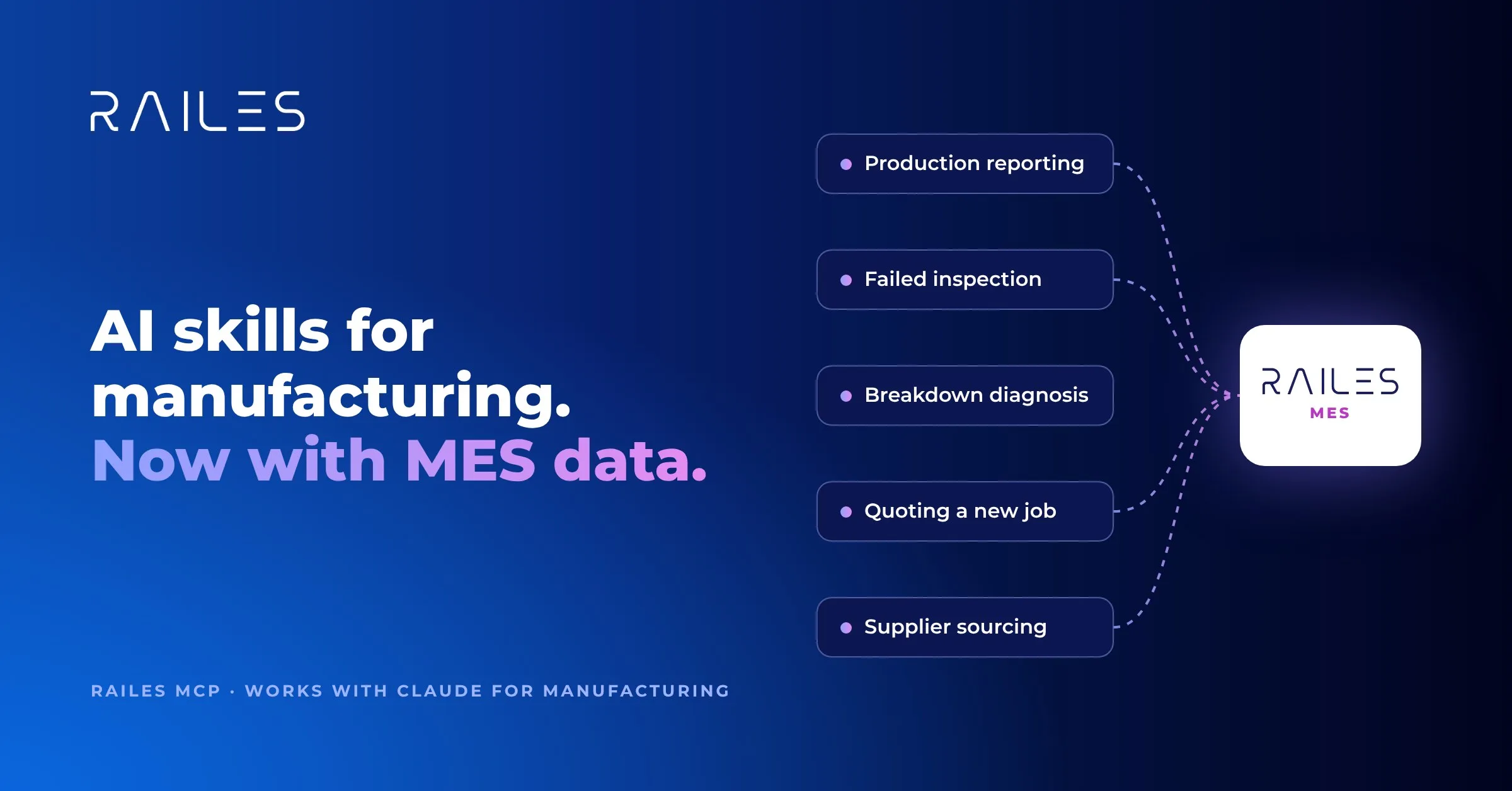
Production reporting. The reporting skill asks for output against target, downtime and the cost of both. With RAILES MCP, Claude pulls orders, times and downtime straight from RAILES Production Management and delivers the shift report, with a link to every source record.
Failed inspection. The quality skill documents the failure, searches past cases and ranks likely causes. In RAILES, that means combining, within Quality Management, inspection results, previous nonconformances, raw-material batches and process parameters, all in the same system.
Breakdown diagnosis. The maintenance skill combines intervention history, repair notes and manuals. RAILES MCP provides the equipment history and the context of the order running when the machine stopped.
What you can do with RAILES MCP: interactive table
Filter by area or search. For each use case, see what you can ask Claude, what data RAILES MCP provides and which Claude for Manufacturing skill comes into play.
Query reads data in RAILES Action w/ approval changes data in RAILES, confirmed by a person and subject to permissions
| Area | What you can ask | What RAILES MCP provides | Claude for Manufacturing skill | Type |
|---|---|---|---|---|
| Production | “Build the shift report for line 2: output vs. target, downtime and cost.” | Production orders, quantities, times, downtime and reasons | Reporting on production | Query |
| Production | “OEE dropped on Tuesday. What explains it?” | Availability, performance and quality by equipment and shift | Reporting on production | Query |
| Production | “Which orders are at risk of missing their due date?” | Scheduling, status and progress of orders | Claude via RAILES MCP (no ready-made skill) | Query |
| Quality | “Batch 4521 failed inspection. Find similar cases and rank the likely causes.” | Inspection results, previous nonconformances, raw-material batches, process parameters | Investigating a failed inspection | Query |
| Quality | “Draft the 8D / CAPA from the records.” | Nonconformance history and previous actions | Investigating a failed inspection | Query |
| Quality | “Open a nonconformance for this batch with this data.” | Creation of a quality record in RAILES | Claude via RAILES MCP (no ready-made skill) | Action w/ approval |
| Maintenance | “M‑14 has stopped. What should I check first?” | Failure and intervention history, running order, downtime context | Diagnosing a breakdown | Query |
| Maintenance | “Which equipment is overdue for preventive maintenance?” | Maintenance plans and intervention status | Claude via RAILES MCP (no ready-made skill) | Query |
| Maintenance | “Create a maintenance request for M‑14.” | Creation of a maintenance request | Claude via RAILES MCP (no ready-made skill) | Action w/ approval |
| Warehouse | “Which raw materials will drop below minimum with the planned orders? Draft the request for quotes.” | Stock, reservations and planned consumption | Sourcing from another supplier | Query |
| Warehouse | “Trace raw-material batch L‑123 to the finished-goods batches.” | Batch genealogy and traceability | Claude via RAILES MCP (no ready-made skill) | Query |
| eBR / Pharma | “Summarize the deviations and exceptions in this batch record before QA review.” | Electronic batch record, deviations, exceptions and audit trail | Claude via RAILES MCP (no ready-made skill) | Query |
| eBR / Pharma | “Compare critical process parameters across the last 20 batches.” | Process parameters and results by batch (supports annual product review) | Claude via RAILES MCP (no ready-made skill) | Query |
| Sales | “For this customer request, what did it cost us to produce similar items?” | Actual times, consumption and yields from previous orders | Quoting a new job | Query |
| Setup | “Set us up.” | RAILES connection tested and active skills identified | Setup | Query |
Skill names match those described by Anthropic at launch. Where there's no ready-made skill, Claude answers directly with RAILES MCP data, and every company can build its own skills.
What about regulated industries like pharma?
This is where the combination is most interesting, and where rigor matters most. For pharmaceutical manufacturers running electronic batch records in RAILES, AI can drastically cut the time needed to prepare a batch review, a deviation investigation or an annual product review. But accountability doesn't change hands.
That's why RAILES MCP is designed around three rules: AI queries data within the user's permissions; any action in the MES requires human confirmation; and the electronic signatures required by 21 CFR Part 11 and EU GMP Annex 11 are still applied by people, inside RAILES. Claude for Manufacturing follows the same philosophy: every skill ends with a review by the person responsible.
What if a company doesn't use Claude?
RAILES MCP isn't tied to one AI vendor. Because MCP is an open protocol, RAILES MCP can be used by any MCP-compatible assistant, platform or agent framework, including agents built in-house. It also complements the integrations RAILES already has with ERP and other systems. The difference is the starting point: with Claude for Manufacturing, the manufacturing skills already exist; with other clients, RAILES data is available, but the workflows have to be designed by whoever implements them.
Conclusion: the MES as the single source of truth for industrial AI
AI in manufacturing is only as good as the data it can reach (we wrote about this in Is Your Manufacturing Data Ready for AI?). An excellent model working on yesterday's export still gives yesterday's answers. Claude for Manufacturing brings the method; RAILES MCP brings current, governed shop-floor data.
With RAILES MCP, RAILES customers will be able to use the full potential of Claude for Manufacturing: from production reporting to quality investigations, from breakdown diagnosis to quoting, with the MES as the single source of truth. And because MCP is open, with the freedom to choose the AI that best serves each operation.
RAILES MCP arrives in 2027 with RAILES V5
Want to see how RAILES MCP applies to your plant? Book a demo or talk to the RAILES team.
Read more on the RAILES website
- MCP in Manufacturing: How to Connect AI to MES Production Data
- Is Your Manufacturing Data Ready for AI?
- Artificial Intelligence in RAILES
- RAILES for Pharmaceuticals Manufacturing
Sources
Frequently Asked Questions
It's the Model Context Protocol server for the RAILES MES. It lets MCP-compatible AI assistants and agents, such as Claude, query production, quality, maintenance, warehouse and eBR data directly in RAILES, in natural language and within each user's permissions.
It's an Anthropic plugin, launched on November 12, 2026 for Claude Team and Enterprise plans, with 17 manufacturing skills and 4 connectors to business systems.
Through RAILES MCP, which connects Claude directly to the RAILES MES. Data is queried at the moment of the question, with no file exports and no manual work.
No. MCP is an open protocol, and RAILES MCP can be used by any compatible client or framework. The Claude for Manufacturing skills are specific to Claude.
RAILES MCP focuses on queries. Actions in the MES require human confirmation and follow user permissions; electronic signatures (21 CFR Part 11, EU GMP Annex 11) are still applied by people.
In 2027, with RAILES version 5. It is currently in testing.
See RAILES MES in action
Talk to our team and find out how a Manufacturing Execution System can improve your production.
Book a demo

